
Fintech Talent Acquisition India Trends That Are Changing Executive Hiring
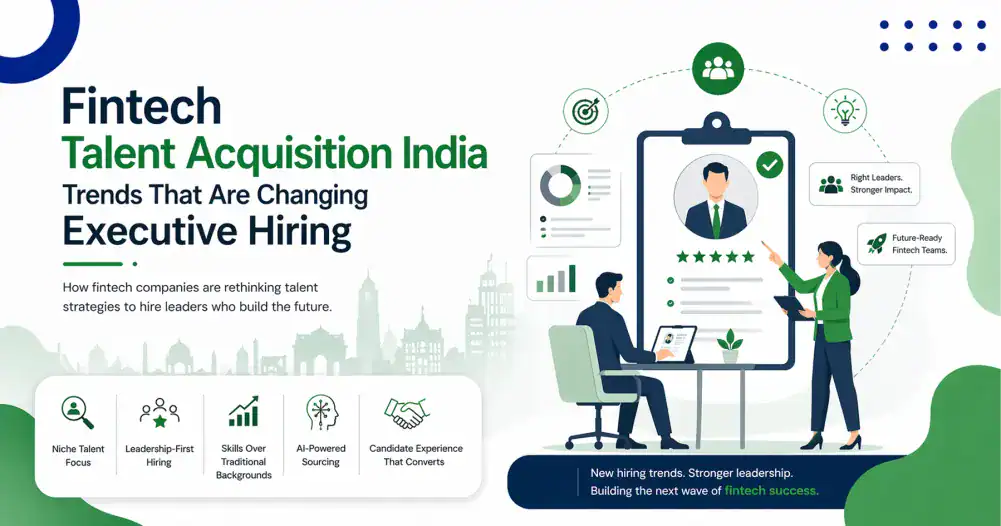
India’s fintech sector added over 2,500 new companies between 2022 and 2025. Funding dried up, then returned. Regulations tightened, then evolved. Several high-profile fintechs went from unicorn valuations to emergency restructuring and the one variable that consistently separated companies that survived from those that did not was the quality of the leadership team.
Executive hiring in Indian fintech is no longer what it was three years ago. The assumptions that once guided how companies hired their CEOs, CTOs, CFOs, and CROs have been overtaken by a new operating reality one that demands sharper criteria, faster execution, and a much more honest conversation about what kind of leader a company actually needs right now.
This blog examines the trends that are actively reshaping C-suite talent acquisition in India’s fintech sector and what they mean for companies that are serious about building leadership teams that last.
Trend 1: The Shift From Credential-Matching to Problem-Matching
For most of the last decade, fintech companies hired C-suite leaders based on brand-name pedigree. IIT + IIM + ex-McKinsey + ex-Goldman Sachs. The formula felt safe because it was defensible to investors and board members.
That formula is breaking down.
Companies that hired by credential found that executives who looked exceptional on paper often struggled with the ambiguity of a fast-moving fintech environment. A CFO who spent fifteen years in structured banking does not automatically know how to manage burn rates, VC dynamics, and a real-time data infrastructure simultaneously. A CMO who built brand at a legacy FMCG company may have no instinct for performance marketing in a regulated fintech context.
The companies winning the talent game in 2026 are hiring for problem-fit over pedigree. The question driving every C-suite executive search mandate has shifted from “who is impressive?” to “who has solved this specific problem, at this company stage, in a context this company will actually recognise?”
This shift requires a fundamentally different search methodology one where C-suite headhunters are briefed not just on the role requirements but on the business problem the new leader must close within their first six months. It is more demanding to define. It produces dramatically better outcomes.
Trend 2: Regulatory Pressure Is Creating Entirely New C-Suite Roles
Three years ago, most Indian fintechs did not have a Chief Risk Officer. They had a risk function usually sitting under the CFO or the COO staffed by people who understood credit risk but had limited exposure to regulatory risk, cyber risk, or data governance.
That structure is no longer viable for any fintech operating at meaningful scale.
The Reserve Bank of India’s evolving frameworks around digital lending, payment aggregators, and co-lending arrangements have made regulatory literacy a board-level requirement. The Digital Personal Data Protection Act has turned data privacy from a compliance checkbox into an operational discipline. Cyber incident reporting norms have created accountability structures that require a senior executive to own them.
The result: executive recruitment for senior leadership roles in fintech now includes a wave of mandates for Chief Risk Officers, Chief Compliance Officers, Chief Data Officers, and Chief Information Security Officers that simply did not exist at this volume two years ago.
These are narrow, highly specialised talent pools. The executives who genuinely qualify for these roles with direct experience in DPDP Act implementation, RBI-regulated company operations, and enterprise-grade cyber governance are few, passive, and not responding to job postings. Reaching them requires headhunting services for C-suite executives with deep networks in India’s financial services regulatory ecosystem.
For companies that have not yet built these functions, the time to start is not after a regulatory notice. It is now.
Trend 3: The Rise of the Operator-Class CXO
India’s fintech investor community has gone through a significant re-calibration. The growth-at-all-costs playbook that defined 2019 to 2022 has given way to a clear preference for companies showing operating efficiency, unit economics discipline, and a credible path to profitability.
This has changed the profile of the ideal C-suite hire at nearly every fintech in India.
Boards are no longer looking primarily for visionaries. They are looking for operators executives who have built cost structures that survived a funding winter, who have managed teams through a down round without losing key people, who understand the difference between revenue and retained revenue, and who can hold a board-level conversation about path to profitability without needing a finance team to prepare the talking points.
The C-suite leadership hiring mandates that Worksource Consultant runs today look materially different from those of two or three years ago. The client brief now routinely includes phrases like “has managed a P&L restructuring,” “has led a company through profitability transition,” and “has built internal financial controls from scratch.” These are operator credentials not strategist credentials and they require a different search approach to find.
C-suite recruitment India firms that have not recalibrated their talent maps to reflect this shift are presenting clients with yesterday’s candidates for today’s problems.
Trend 4: Speed-to-Shortlist Is Now a Competitive Requirement
India’s fintech talent market in 2026 is not just competitive it is fast. The window between when a high-quality passive candidate becomes open to a conversation and when they are either re-committed to their current role or taken by a competitor is often less than 60 days.
Companies that run slow, consensus-heavy hiring processes are consistently losing their best candidates not to better offers, but to faster ones. An executive who is genuinely excited about an opportunity will lose that excitement after three rounds of rescheduled interviews, two weeks of silence from the hiring company, and a final-round process that takes 45 days to produce a verbal offer.
This is why C-suite hiring solutions that include a defined process timeline brief to shortlist in 45 days, shortlist to offer in 30 days are not just a service level metric. They are a competitive requirement.
Worksource Consultant guarantees a curated, interview-ready shortlist within 60 days of brief sign-off. This commitment is not marketing language it is backed by a defined search methodology and a senior-led process with no junior hand-offs. The hiring company’s internal process after that point determines whether the speed advantage is preserved or lost.
The lesson for fintech CHROs and founders: if your internal process cannot make a decision within 30 days of receiving a shortlist, your best candidates will be gone before you make an offer.
Trend 5: Employer Brand Is Now a Factor in C-Suite Attraction
Three years ago, a strong equity package and a compelling growth story were sufficient to attract most C-suite candidates to a fintech. That calculus has changed.
Senior executives who lived through 2022 and 2023 when several well-funded fintechs underwent mass layoffs, abrupt pivots, and in some cases, regulatory shutdowns are now significantly more diligent about the companies they join. They conduct their own due diligence. They speak to former employees. They assess the founder’s reputation, the board’s composition, and the company’s regulatory standing before they take a first meeting seriously.
This means fintech companies with weak employer brands or worse, with unaddressed reputational issues from previous leadership decisions are finding that their compensation packages are insufficient to attract the quality of executive they need. The executive talent acquisition for top management process now begins well before a search firm is engaged: it begins with how a company treats its existing team, communicates during difficult periods, and presents itself in the market.
C-level recruitment in 2026 requires companies to be just as attractive to passive senior candidates as they are to retail customers. Companies that have invested in their leadership reputation are consistently building stronger shortlists and closing offers faster than those that have not.
Trend 6: The Board Is Now Directly Involved in C-Suite Talent Strategy
In earlier stages, most fintech hiring decisions including at the C-suite level were made by founders with limited board involvement. That has changed significantly as institutional investors and independent directors have become more active participants in India’s fintech ecosystem.
Boards are now setting explicit expectations around leadership composition: diversity at the CXO level, functional coverage across risk and compliance, and in many cases, direct board involvement in the final stage of senior executive selection.
This has elevated the standard for C-suite hiring consultants to operate not just with the founding team but with board-level stakeholders managing different sets of expectations, facilitating alignment when founder and board priorities diverge, and delivering candidate assessments that are credible to institutional investors, not just operationally satisfying to the CEO.
C-level hiring consultants for companies in India who work at this level are not just search professionals. They are trusted advisors to multiple stakeholders simultaneously and that dynamic requires a different quality of judgment and communication than a transactional hiring engagement.
Trend 7: AI Literacy Is Now a Baseline CXO Requirement
This trend cuts across every C-suite role in fintech, not just technology leadership. Boards and founders are now asking a simple question about every executive candidate: do they understand how AI tools are changing the function they will lead?
A fintech CFO who cannot articulate how AI-driven financial modelling, anomaly detection, and automated reporting will change the finance function in the next three years is behind the curve. A CMO who has not built AI-assisted acquisition and retention workflows is operating with structural disadvantage. A CHRO who is not thinking about AI’s impact on talent sourcing, performance management, and compensation benchmarking is not the CHRO a forward-thinking fintech board wants.
Leadership recruitment services India that screen for AI literacy at the C-suite level are not looking for technical depth in every function. They are looking for strategic awareness the ability to understand what AI changes, make decisions about where to invest, and lead teams through the transition without either over-indexing on hype or dismissing the shift entirely.
This is now a standard assessment criterion in every executive search for C-suite mandate Worksource Consultant runs in the fintech sector.
FAQ: Fintech Executive Hiring Trends in India
Q1 : Which C-suite role is hardest to fill in Indian fintech right now?
A: Chief Risk Officer and Chief Compliance Officer mandates are consistently the most challenging. The talent pool with genuine regulatory depth in India’s fintech context DPDP Act, RBI frameworks, SEBI digital guidelines is very small, and demand has increased sharply in the last 18 months.
Q2 : How has the ideal fintech CEO profile changed in 2026?
A: Boards are now prioritising operators over visionaries. The fintech CEO hire in 2026 is expected to have demonstrated profitability management, not just fundraising success. Revenue quality, customer retention, and regulatory standing have all moved up the priority list relative to GMV growth.
Q3 : Are international executive candidates being considered for Indian fintech C-suite roles?
A: Yes, selectively. For CTO and product leadership roles, international candidates with relevant market experience are increasingly considered particularly those with Southeast Asia or UK digital banking backgrounds. For compliance and regulatory roles, deep India-specific knowledge is almost always non-negotiable.
Q4 : How important is cultural fit versus functional capability in a fintech CXO hire?
A: Both matter but cultural fit determines tenure while functional capability determines performance. A technically excellent CXO who misaligns culturally will exit within 18 months. A culturally strong CXO who is slightly below the technical ceiling can grow into the role. Most C-suite recruitment firm assessments now give equal weight to both dimensions.
Q5 : What is the biggest mistake fintech companies make when hiring C-suite leaders?
A: Moving from shortlist to offer without adequate internal alignment on compensation, equity, and reporting structure. These conversations should happen before the search begins not after a candidate is excited about the role. Mid-process surprises on package or scope are the primary reason strong offers are declined.
The Right C-Suite Talent Strategy Starts Before the Vacancy
The companies that consistently build strong fintech leadership teams do not wait for a leadership gap to start thinking about their next hire. They maintain an ongoing relationship with a trusted C-suite recruitment firm mapping the market, tracking leadership quality across competitors, and staying ready to move decisively when a mandate opens.
Worksource Consultant partners with fintech companies across India on C-suite recruitment India mandates at every stage from placing a first professional CEO to building out a full CXO bench ahead of a public market event. Our process is retained, confidential, and driven by senior consultants with direct fintech sector knowledge.
If the leadership trends described above are raising questions about your own C-suite composition, this is the right moment to have that conversation.
Start Your C-Suite Executive Search → Talk to Our Leadership Hiring Team →
Worksource Consultant | C-Suite Recruitment India Fintech | BFSI | Technology | High-Growth Companies Across India